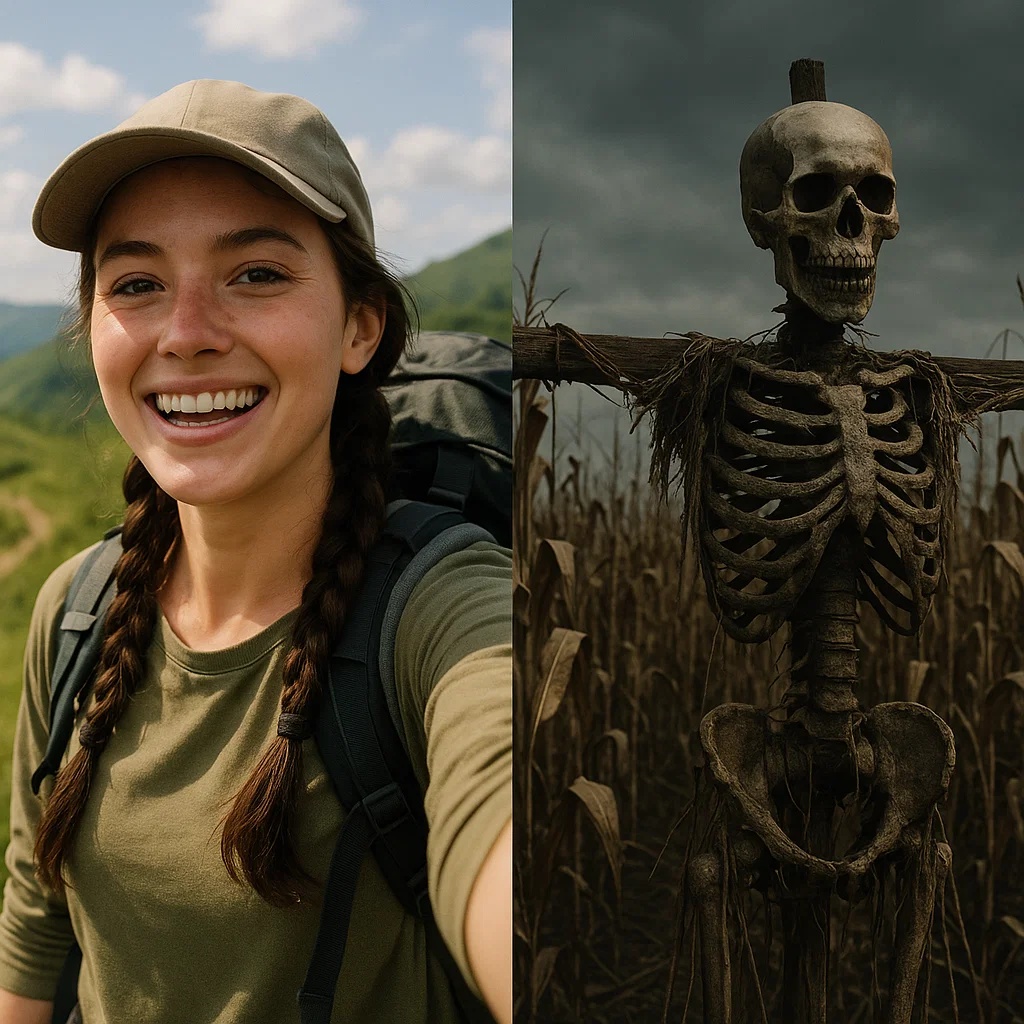
They found her in a scarecrow two years after she disappeared. Her bones, intertwined with rotten straw, were nailed to a wooden cross in the middle of a vast cornfield in Virginia. This story isn’t about the wild nature of the Appalachian Trail and its dangers. It’s about
about a monster that lived in plain sight, waving to passing cars and staring each day at its hideous creation, which it called Scarecrow.
It all began in the summer of 2005. For 24-year-old Sara Jenkins from Columbus, Ohio, it was supposed to be the summer of her life. She had just graduated with a degree in journalism, and before diving into adult life with an office job and a mortgage, she decided to fulfill her lifelong dream: to travel alone.
a significant portion of the Appalachian Trail.
Sara wasn’t a professional hiker, but she was well-prepared. She spent months researching routes, reading blogs and books by experienced hikers, and buying gear. She was strong, independent, and full of optimism. Her parents were worried, of course, but proud of her.
Their daughter’s determination.
To them, she was their bright and courageous daughter, who always got what she wanted. Sara had a small but popular travel blog called Sara Sees the World, where she planned to document every step of her adventure with writing and photos. In early June 2005, she said goodbye to her family and flew to
Georgia, the starting point of his journey.
The first few weeks of the trek were exactly as he had dreamed. He hiked north, through dense forests, climbing picturesque peaks, and meeting other travelers along the way. He updated his blog regularly. He wrote about the beauty of nature, the challenges of
The long journeys and the kindness of strangers, the angels of the road, who helped tourists with food and shelter.
Her photos conveyed the grandeur of the mountains and her own sense of freedom and happiness. She regularly called her parents from the small towns where she stopped to restock supplies. The last time they spoke to her was at the end of July. She was in Virginia; she had already hiked
She had traveled over 1,000 km and felt great.
She was full of enthusiasm and said the next leg of the journey was excellent, although quite isolated. Her last blog post was dated July 28, 2005. She published it from an internet café in the small town of Dalville, Virginia. In it, Sara humorously described her struggle against
The blisters and her dreams of a real cheeseburger.
She wrote that she was entering one of the wildest parts of the trail and probably wouldn’t have another chance to make contact for a week or 10 days. She ended the entry with the words: “The mountains are calling me and I have to go. Don’t lose me.” Those were her
Last words published.
When 10 days passed and there was no news of Sara, her parents began to worry. After two weeks, they raised the alarm. They contacted the Appalachian Trail Association and the local police. A search operation was launched immediately. Dozens of
Park rangers, police officers, and volunteers, many of them experienced hikers, began combing the section of the trail where Sara was believed to have disappeared.
The search was arduous. This area of the Appalachian Mountains is hundreds of square kilometers of dense forests, rocky cliffs, and deep canyons. The trail is just a thin thread in this vast wilderness. Searchers checked every cabin and shelter along the way.
In the logbook of one of the shelters, they found her last entry, apparently written on July 29 or 30. A brief note about the time and the signature Sara J. After that, her trail went cold. The police questioned other tourists who might have been in the area at the same time.
Some remembered seeing a lone girl who resembled Sara, but no one could say anything definitive.
There are so many people on the trail that faces are easily forgotten. Days turned into weeks. Search teams combed every inch of the official route and the surrounding area. Helicopters circled overhead, but found nothing—not her bright red backpack, not her tent.
neither his campaign nor his camera.
There were no signs of a struggle, nor any indication that she had left the trail. It was as if an experienced, well-trained woman had vanished on a well-marked route. All possibilities were considered, including an accident. But in that case, it was more likely they would have found her.
body or equipment.
An attack by a wild animal, highly unlikely in that area. And again, there would have been traces. An abduction. This version seemed the most terrifying and the most realistic. Someone could have located a girl alone and taken her off the trail. A month passed, then another. The search operation to
Large-scale operations were officially suspended. Sara’s parents, heartbroken, spent all their savings on private investigators, but even they couldn’t find any leads.
Sarah Jenkins’ story made national news for a while. However, as always, it was overshadowed by other, more recent tragedies. For the world, her story became just another unsolved mystery of the Appalachian Trail—a cautionary tale that tourists sometimes take to heart.
They told stories around the campfire, but for their family and friends, the pain never disappeared.
The void left by their disappearance was unbearable. For two years they lived in agonizing uncertainty, and none of them could imagine that the answer to their questions had been there all along, not in the remote forest or the mountain gorge, but just a couple of steps away.
Miles of trail, at an old farmhouse, an ugly scarecrow stood in the middle of a cornfield, staring blankly at the passing hikers with empty button eyes.
Two years passed; it was August 2007. Summer in the Shenandoa Valley was drawing to a close, painting the hills in deep shades of green and gold. The corn in the fields stood tall and thick, waiting to be harvested. Life in this rural part of Virginia moved as slowly as ever.
The story of the hiker who disappeared on the trail became a local legend,
a stark reminder that the unforgiving wilderness of the surrounding area was unforgiving. Farmers worked the land, and one of them was Silas Blackwood, a 70-year-old man whose farm bordered the national forest. He was a local. His family had owned
of the Earth for generations.
The neighbors who lived a mile away knew him as a quiet, unsociable widower. His wife had died 20 years ago, and his only daughter had moved across the country long ago and rarely visited her father. Silas was one of those people who seemed to have
He had grown up in the land.
He rarely went to town, hardly spoke to anyone, and spent his days on his farm. People considered him a harmless eccentric. Every spring he placed a scarecrow in the middle of his main field, and there was nothing strange about that. But for the last two years, his scarecrow had
It had been strange.
It was disproportionately large, somehow deformed and dense. Its clothes were unusual too. It wasn’t an old farmer’s jumpsuit, but faded women’s trousers that looked like hiking pants and a very worn synthetic jacket. But nobody paid any attention to it. Who knows what
What kind of junk would an old man put on a wooden cross? The denouement came in the last week of August.
A fierce summer storm swept through the region. It rained heavily for several hours, and the wind seemed intent on uprooting the old oak trees. The next morning, when the storm subsided, the entire valley looked devastated. Broken branches littered the roads and cornfields.
They were devastated. Jim, one of Silas’s neighbors, was driving his pickup truck to assess the damage to his crops.
His route took him past the Blackwood farm. As he drove through the cornfield, he noticed that the old man’s famous scarecrow hadn’t survived the storm. It was broken at the base and lying on the ground in a mud puddle. One of its arms was broken off, and the whole structure was in pieces.
collapsed.
But that wasn’t what caught Jim’s eye. Something white and smooth that looked nothing like the straw of the torn burlap that served as the scarecrow’s body. Jim pulled the truck over to the side of the road. Curiosity got the better of him, overcoming his desire to get on with what he was doing. He got out of the truck, climbed
He climbed over a low fence and crossed the field toward the fallen scarecrow.
As he approached, he caught a faint but nauseating, sickly-sweet smell. He bent down and pushed aside the damp, rotten straw. What he saw made him recoil and scream. A human skull stared at him from among the rags. Nearby were other bones mixed with mud and scraps of clothing. Jim,
Forgetting about his crops, he ran to his car.
His hands were shaking so badly he could barely dial 911. Twenty minutes later, the sheriff’s cars pulled up in front of Silas Blackwood’s farm. The old man greeted them on the porch of his dilapidated house, a cup of coffee in his hands. He seemed calm, even slightly annoyed.
for having been interrupted in his morning solitude.
While the group cordoned off the field and the site of the gruesome discovery, the sheriff began to speak with Blackwood. The old man answered the questions about the scarecrow slowly and calmly. Yes, it frightened him. The storm had broken it. These things happen. What’s inside? He shrank from
Shoulders. Straw, old rags, whatever I could find.
He said it with such indifference that a chill ran down the experienced sheriff’s spine. He realized that this man was either the best actor in the world or a complete psychopath. While this conversation was taking place, the forensic experts were already working in the field. The scene
It was gruesome.
The scarecrow was indeed filled with human remains. The bones were broken and mixed with straw to give the structure volume and shape. Among the bones, experts found remnants of fabric, the same synthetic jacket the scarecrow was wearing. And in the mud, under the
A broken torso revealed what would become one of the key pieces of evidence: a heavy hiking boot strapped to the remains of a human ankle.
The case immediately became a priority for the county police. The sheriff quickly recalled an unsolved case from two years earlier. The missing tourist was Sara Jenkins. She had disappeared on the section of the trail that ran a couple of kilometers from the farm.
Blackwood, through the woods adjacent to his property.
The probability of it being a mere coincidence was nil. The case, unsolved for two years, suddenly became the most publicized in the county’s history. Silas Blackwood was arrested that same day as a person of interest. He did not resist; he allowed himself to be handcuffed.
He remained silent and got into the patrol car.
During his first interrogation, he behaved the same way, silent and staring at a point, occasionally repeating his version of events: that he had found the bones in the woods and decided to get rid of them so no one would see them. He claimed he was scared and
He said he didn’t know what to do, but his story was full of inconsistencies.
Nobody believed a word he said. While he denied everything in the interrogation room, a thorough search was launched at his farm to uncover what other secrets this quiet, secluded corner of rural America held. The investigators were certain they would find something there.
The answers to all their questions.
While forensic experts dismantled the gruesome contents of the scarecrow at the Blackwood farm, Silas himself sat in a sterile interrogation room at the sheriff’s office. He was like a statue. Hour after hour, detectives tried to break through his wall of silence,
But he just kept repeating his absurd story. “
I found him in the woods, I got scared, I hid him.” He said it monotonously, without emotion, looking at his calloused, age-worn hands. His calmness was unnatural and terrifying. He wasn’t acting like a frightened old man who’d gotten into trouble; he was behaving like a man who had a plan.
for this situation and was following him methodically.
The detectives realized that without solid evidence they wouldn’t be able to get him to talk. All their hopes rested on the team searching his farm. Blackwood’s farm was a time capsule. The house where he had been born and raised seemed unchanged for the past 50 years.
Everything was covered in a thick layer of dust, and the air was thick with the smell of dampness and loneliness.
The police methodically combed, room by room, this repository of a life long gone. They lifted floors, checked walls, and searched the contents of every drawer. Most of what they found was old junk, old newspapers, broken tools, his clothes
The deceased wife’s body was carefully folded in trunks.
After several hours of searching, they found nothing relevant to the case, but the investigators knew that murderers often keep trophies, objects that belonged to their victims, and they were certain that Silas was no exception. The breakthrough came in an old, dilapidated barn where
Blackwood stored his farming tools.
In a far corner, under a pile of rusty chains and old tires, one of the agents stumbled upon an old army box secured with a large padlock. The lock was quickly engaged. When the lid of the box was opened, everyone realized the search was over.
Inside, carefully wrapped in burlap, lay a bright red hiking backpack.
It was dirty, but otherwise intact. With trembling hands, the forensic expert began to remove the contents. There was a sleeping bag, a small notebook that had served as Sara’s journal, a map of the Appalachian Trail with handwritten notes, and most importantly, a
A digital camera in a protective case.
It was her camera, the same one she had used to take the photos for her blog. The find was immediately taken to the police station. While the experts examined the camera, the sheriff ordered Sara’s journal to be brought into the interrogation room. He placed it on the table in front of Silas.
It looks familiar, Mr. Blackwood.
The old man glanced at the notebook and looked back at the table without saying anything, but the detectives noticed a twitch in his cheek for a second. Meanwhile, the forensic experts at the lab confirmed what was already obvious. Comparing Sarah Jenkins’ dental records, sent
From Ohio, using the jawbone found in the scarecrow, they reached a 100% conclusion.
The remains belonged to her. The missing person case was officially closed, and a murder investigation was opened, but the real blow for Silas Blackwood came from Sara’s camera memory card. The experts had no problem recovering all the
files.
There were several hundred photos on the card. The first ones were taken in Georgia and Tennessee. Picturesque landscapes, selfies of a smiling Sara with the mountains in the background, and photos of other tourists she had met along the way. As they reviewed them, the detectives felt as if they were
Retracing his final journey, seeing the world through his eyes.
The closer they got to the end, the more photos there were of the Virginia woods. Here were the last tranquil images: a stream flowing between rocks, a deer venturing onto a trail, his own tent pitched at sunset. And then came the final five photos. These
Five images were unlike any other.
They were blurry, snapped in a panic from close range. The first showed a man’s plaid shirt. The second was a blurry shot of the ground and someone’s boots. The last three were the most terrifying. It was a face, a man’s face contorted with rage, staring
directly to the camera. Despite the poor quality and the camera shake, the photos clearly showed Silas Blackwood.
A little younger than he is now, but it was him. In the last moments of her life, in a desperate struggle, Sara did what she did best. She documented the truth, she photographed her killer. The sheriff entered the interrogation room with large printed photographs in his hands. He sat down
He remained silent before Silas and placed the first photograph on the table.
It was Blackwood’s face, photographed by Sara. The old man looked at the photo, and his body tensed for the first time during the entire interrogation. The sheriff placed the second photo next to it, and then the third. He said nothing, only stared at Silas. The old man’s stony expression began to
His lips trembled.
He was staring at his own face, captured at the moment he committed a monstrous crime. The silence in the room became deafening, and then, after several minutes of this tense silence, Silas Blackwood looked up at the sheriff. The wall crumbled. With a voice so calm and
Squeaking like an ungreased door, he uttered his first sincere words in two years. It was hot that day.
Very hot. With these words, Silas Blackwood began his confession, and the more he spoke in his calm, emotionless voice, the more terrifying the image of that July day in 2005 became. He made no attempt to justify himself, nor did he show any remorse. He recounted the facts as if he were speaking about
planting corn or repairing a fence.
That day, as usual, he was working at the far end of his property, which bordered the forest. He often saw tourists walking along the path, bright specks against the green background. He despised them. To him, they were strangers, intruders in his isolated world, happy people and
carefree, living a life that, for him, had long since ended.
When he saw Sara, she had left the main path and was walking along an old, overgrown trail that led to a stream on his property. She probably wanted to drink water or wash her face. He said there was something about her that drove him crazy. Her youth, her confidence, her red backpack
Brilliant. In his sick mind, poisoned by loneliness, she became a symbol of everything he had lost and hated.
It wasn’t a planned action; it was a pure, predatory impulse. He waited for her, hidden behind the trees. When she crouched down toward the stream, he attacked her. He told her that she resisted desperately. She was strong and fought tooth and nail for her life. It was at that moment, as he tried
He snatched the camera from around her neck as she took the photos.
It was chaos, screams no one could hear, and the click of the camera shutter. He raped her, and when he realized she had seen his face and could identify him, he strangled her. He recounted all of this with terrifying coldness. After the murder, he dragged the body to some dense thickets of
blackberries growing on his land, knowing that search teams would never enter private property,
took the backpack and hid it in a shed. He returned home, washed up, and worked in the fields for the rest of the day as if nothing had happened. The most chilling part of his confession was about the scarecrow. He said the idea didn’t come to him immediately. Sara’s body remained
In the bushes all winter, hidden under the snow.
In spring, when it was time to prepare the field for planting, he decided he didn’t want to bury the bones. It seemed too simple and boring. He wanted, in his own words, to have her close by. It was his twisted way of maintaining control, his terrible secret that was already hidden.
in full view of everyone.
At night he would gather what was left of Sara in a bag. Then, by moonlight, in his barn, he would build a new scarecrow. He mixed her bones with straw, stretched burlap over a wooden cross, and dressed his creation in Sara’s traveling clothes. For him, it was the final act of
Humiliation and power.
For almost two years, he looked out the window every day at that scarecrow. He saw other tourists waving to him from afar, mistaking him for an ordinary farmer, and none of them knew that they were not only waving to a murderer, but also to his victim. The trial of Silas Blackwood was
Given his full confession, backed by material evidence—Sara’s diary and camera, as well as the DNA test results—the defense had virtually no chance.
The lawyers tried to prove his insanity by pleading senile dementia and the effects of prolonged social isolation, but the prosecutor presented his confession to the court—a cold, methodical, and detailed account that could not have come from a man unaware of his actions. And when they were shown to the jury…
As the last photos taken by Sara were shown, a profound silence fell over the courtroom.
Those blurry, panicked images were the prosecution’s most compelling evidence. It was Sara herself speaking from beyond the grave, pointing to her killer. Silas Blackwood was found guilty on all counts, including first-degree murder, kidnapping, and rape. The judge, upon reading the
The court described his actions as an act of absolute evil beyond human comprehension.
He was sentenced to life imprisonment without the possibility of parole. For Sara’s parents, the verdict marked the end of a long nightmare, but it brought them no relief. They knew the truth, but that truth was unbearable. At the trial, her father said they would always be proud of their daughter.
His daughter’s last act. Even in death, he remained a journalist and did everything he could to find her killer.
The news that the quiet farmer Blackwood was a monster shocked the local community. People had lived alongside him for years and had no idea of the darkness lurking behind his unassuming facade. Silas Blackwood died in a maximum-security prison seven years later.
A heart attack.
Her farm was sold, and her old house and barns were torn down. The new owner built a cornfield, erasing all traces of this terrible story from the face of the earth. But it remained. Sarah Jenkin embarked on a journey to share the beauty of the trail with the world.
Appalachian Mountains. In the end, at the cost of his life, he told a completely different and terrifying story.
A story about a scarecrow that wasn’t just a scarecrow.